
An online business is simply a business that earns money through selling products, offering services, or providing content through the internet.
Many beginners feel overwhelmed and don’t know where to start, but once you understand the basics, everything becomes much easier.
You don’t need special skills, expensive tools, or years of experience to start an online business. You just need the right training and the willingness to learn.
In this online business basics guide, I’ll walk you through what an online business is, the different types you can start, and the essential steps to begin building your own.
If you’d like a simple step‑by‑step path to follow, you can also check out my Beginner’s Roadmap.
TLDR
An online business is simply a business that earns money through selling products, offering services, or providing content through the internet.
Starting an online business is best for those who want more freedom and flexibility, are willing to learn and work hard, and want to help people through content and products.
Most myths are misconceptions and exist because of misinformation, hype, and unrealistic promises.
To get started, choose your niche, pick a business model, set up your website or platform, create helpful content or products, promote your business, track your progress, and improve as you go.
You don’t need special skills, qualifications, or expensive tools to begin. All you need is the right training, the correct tools, and a simple plan.
You’re capable of more than you think. So, keep going. Your future business starts with your next step.
Affiliate Disclosure: This post contains affiliate links including WA affiliate links meaning if you sign up for anything using the links on this page I may earn a small commission at no extra cost to you. I only recommend platforms that I genuinely believe will benefit you and suit your needs.
- TLDR
- What Is An Online Business?
- Why Start An Online Business?
- The Main Types Of Online Businesses
- What You Need To Start An Online Business
- The Core Skills You'll Develop Over Time
- Who Is An Online Business Best For?
- The Biggest Myths About Online Business
- How To Start An Online Business
- Tools & Resources For Starting An Online Business
- Conclusion
- Frequently Asked Questions
What Is An Online Business?
An online business is simply a business that earns money through selling products, offering services, or providing content through the internet.
You don’t need a physical storefront, and you don’t need to carry an inventory unless you want to sell physical products.
Compared to a traditional business, an online business has lower startup costs. You don’t need a physical location, your hours are flexible, and you can reach people all over the world.
There are many different types of online businesses you can create, such as:
- A blog
- Affiliate marketing websites
- Digital products store
- Offering freelance services
- Running print-on-demand shops
The possibilities are endless. However, it’s important to understand that running an online business is not a get rich quick scheme, and it won’t make you money straight away.
The good news is it’s something anyone can do, and you don’t need any special skills. Everything can be learned step by step, but it requires time, commitment, and consistency.
Now that you know what an online business is, let’s take a look at why so many people are choosing to start one.
Why Start An Online Business?

Many people choose to start an online business to build something real for themselves. They may be tired of working a 9-5 job, want more freedom, or are seeking control and a better future.
If that sounds like you, you might benefit from starting an online business too.
Benefits Of Starting An Online Business
There are many benefits of starting an online business, including:
- Low startup costs- no rent, no staff, no inventory required
- Flexibility- work anytime, anywhere
- Scalability- you can grow without huge expenses
- Global reach- your audience isn’t limited to your town
- Passive income potential- some models earn even when you’re not working
- No special skills needed- everything can be learned
- You can start part‑time- no need to quit your job
- Control over decisions– Make all the decisions and be your own boss
The benefits are rewarding, and you can build something very successful over time.
What Building An Online Business Can Give You
Starting an online business opens up a lot of doors and gives you many opportunities.
As you grow and become successful, you’ll have the time and ability to do the things you want to do.
You’ll be able to:
- Spend more time with friends and family
- Have the ability to work from home
- Earn extra income
- Possibly replace your job one day
- Gain the freedom to travel or work remotely
This won’t happen straight away. It takes a lot of time and consistency to reach these possibilities.
But it’s an amazing journey, and it’s definitely one worth starting.
Expectations Of Building An Online Business
Building an online business is a commitment. It requires time, effort, consistency and dedication.
You’ll need to find the right training, take the time to learn, and put in the work.
It’s going to:
- Take time
- Require consistency
- Not be instant
- Not make you rich quickly
- Help you learn and grow as you go
- Be a long-term journey
But the rewards are worth it. If you’re serious and work hard, you can change your life and build a successful online business.
Now that you know why so many people are starting online businesses, let’s explore the main types of online business you can create.
The Main Types Of Online Businesses
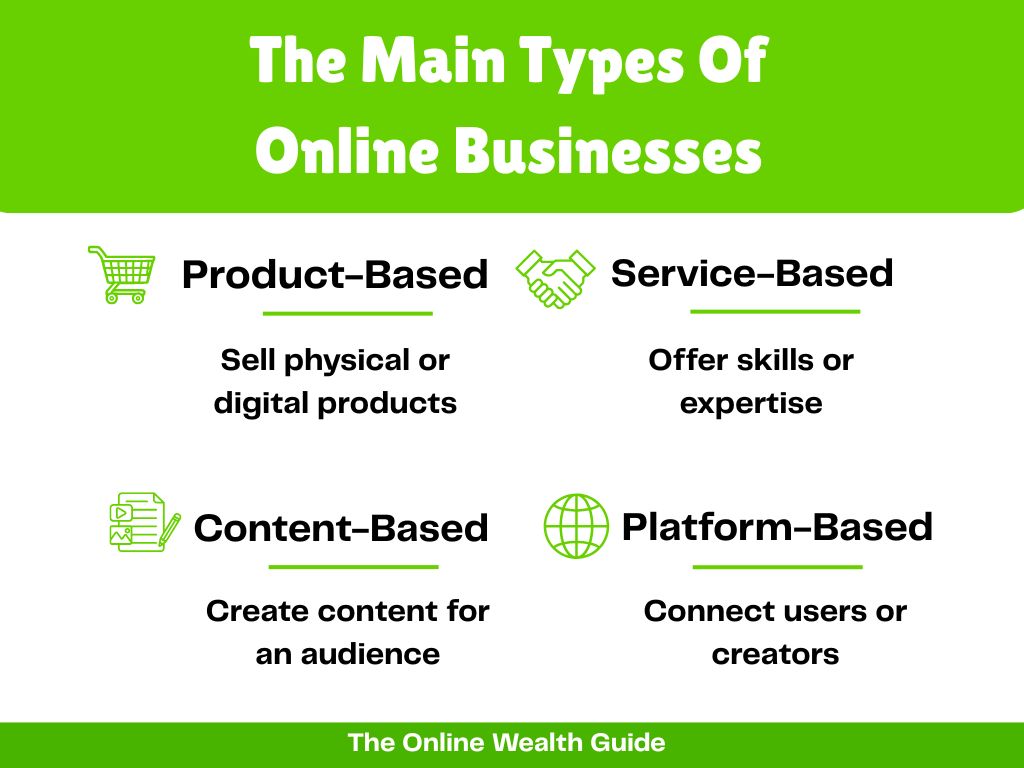
There are 4 main types of online business: Product-based, Service-based, Content-based, and Platform-based.
Each type works differently, but they can all be very successful.
Product-Based
A product-based business is a business where you sell physical or digital products.
You can sell anything you want, and most product-based businesses create content based on their products.
But your main money-making method will come from selling your products.
Examples Of A Product-Based Business
A product-based business can be:
- Ecommerce stores
- Dropshipping
- Print‑on‑demand
- Handmade products
- Digital downloads (templates, planners, eBooks)
It can be anything as long as you’re selling some kind of product.
Pros & Cons
Product-based businesses have advantages and disadvantages.
Here are the pros and cons of a product-based business:
Pros
- Can scale well
- Great for creative people
- Many models don’t require inventory
Cons
- Customer service
- More moving parts
- Physical products require shipping
A product-based business is best for those who enjoy creating products and don’t mind handling customer service.
Service-Based
A service-based business is a business where you offer a skill or perform a service.
You can sell any skill or service you want, as long as it’s something you actually know about and are good at.
You can create content in your niche, but your main money-making method will be your skills and services.
Examples Of A Service-Based Business
A service-based business can include:
- Freelancing
- Coaching
- Consulting
- Web design
- Virtual assistant work
- Social media management
It can be anything as long as you’re selling skills and performing a service.
Pros & Cons
Service-based businesses have advantages and disadvantages.
Here are the pros and cons of a service-based business:
Pros
- No inventory
- Low startup cost
- Fastest way to start earning
- You only need one client to begin
Cons
- Time‑for‑money
- Not passive
- Money stops when you stop
- Requires communication with clients
A service-based business is best for those who have skills they can use to perform services and don’t mind working a lot.
Content-Based
A content-based business is a business where you create content and monetize it.
You can sell products if you want to, but the main focus is creating content consistently and earning money from it.
You will need a lot of content, as it will be what leads customers to your offers or products.
Examples Of A Content-Based Business
A content-based business can include:
- Blogging
- YouTube
- Podcasts
- Affiliate marketing
- Social media content
It can be any model you like, as long as you’re consistently creating content that leads readers to offers or products that make you money.
If you’d like a simple beginner-friendly explanation of how affiliate marketing works, you can read my Affiliate Marketing 101 guide.
Pros & Cons
Content-based businesses have advantages and disadvantages.
Here are the pros and cons of a content-based business:
Pros
- Low cost
- Can become passive
- Perfect for beginners
- Builds long‑term assets
Cons
- Takes time to grow
- Requires consistency
- Results aren’t instant
A content-based business is best for those who enjoy creating content, are willing to be consistent, and don’t mind waiting a while to see results.
Platform-Based
A platform-based business is a business where you build a platform that connects people or provides tools.
It can be any type of platform you like, as long as it connects people, builds a community, and provides something valuable to members.
You’ll usually sell things like apps, tools, and courses, which will be your main money-making method alongside any fees you charge for people using your platform.
Examples Of A Platform-Based Business
A platform-based business can include:
- Marketplaces
- Online courses
- Apps or software
- Membership websites
- Community platforms
It can be anything you like, as long as your platform connects people and provides something valuable to keep them coming back.
Pros & Cons
Platform-based businesses have advantages and disadvantages.
Here are the pros and cons of a platform-based business:
Pros
- Scalable
- High earning potential
- Can create recurring income
Cons
- More complex
- Requires more setup
- Not ideal for beginners
Platform-based businesses are best for those who have experience building websites, apps, or software, and want to create a platform or community to bring people together.
Which Type Should You Choose?
There is no best type of online business. The type you choose depends on your goals and what you want to achieve.
Think about it like this:
- If you want fast income: choose service‑based
- If you want long‑term passive income: choose content‑based
- If you’re creative: choose product‑based
- If you want to build something big: choose platform‑based
Whichever type of business you choose, keep your goals in mind and choose the one that feels right for you.
You can start small and grow as you learn. Don’t rush into anything and take your time building your business.
Rome wasn’t built in a day, and neither is a business. Learn, take your time, and don’t give up. That’s how you get yourself on the way to success.
Now that you understand the main types of online business you can start, let’s discuss what you need to start an online business.
What You Need To Start An Online Business
You don’t need a lot to start an online business, but you do need some core things.
You’re going to need the right mindset, a niche or topic, a website or platform, tools and resources, and a simple plan.
None of these are hard to create. You’ll just need some time to develop each one.
Here’s a detailed breakdown of the core things you need to start an online business.
1. The Right Mindset
The right mindset is important for success and growth.
If you have the wrong mindset or are too negative, you’ll hold yourself back and could end up giving up.
You’re going to need:
- Patience
- Consistency
- Realistic expectations
- The willingness to learn
- Commitment to long‑term growth
You don’t have to be an expert. You just need the right mindset and the willingness to learn.
2. A Niche Or Topic
Your niche is your audience, target market, and topic for your business. It doesn’t need to be perfect, but it should be something you can work with.
You should:
- Choose something you’re interested in
- Ensure it’s a niche with an audience
- Select a niche you can stick with long-term
- Go with something you can talk about and enjoy learning about
Your niche doesn’t have to be perfect. It just needs to suit you.
3. A Website Or Platform
Having a website or platform is essential for your business.
Without it, people won’t know you exist and will have trouble finding your products and services.
Your own website or platform can be:
- A website or blog
- A YouTube channel
- A storefront
- A social media account
- A niche-related community
Your website or platform is your home base. It’s where people can find your content, products, and services.
4. Tools & Resources
When starting your online business, you’re going to need some tools and resources.
You don’t need anything fancy or expensive. You just need a few basic things to get you started.
You’ll need:
- A computer or laptop
- An internet connection
- A website builder
- Research and management tools
- Training, education, and ongoing support
Start with the basics and expand or upgrade as you grow.
5. A Simple Plan
A simple plan makes it much easier to get your business up and running.
Without one, you’ll likely be frustrated, overwhelmed, and won’t know where to begin.
So, have a simple plan like this:
- Choose a business type
- Select a niche
- Set up a website or platform
- Create helpful content
- Add products or offers
- Keep learning and stay consistent
You don’t need a complicated business plan. It doesn’t need to be perfect. It just needs to give you direction.
Just a simple roadmap to follow is enough to help you get started alongside your training and education.
Online Business Essentials Simplified
Starting an online business doesn’t have to be overwhelming. Simply find the right training, take the time to learn, and get your business off the ground.
You just need:
- The right mindset
- A niche or topic
- A website or platform
- Basic tools and resources
- A simple plan
With focus and consistency, you can get your business off the ground quickly. Anyone can do it, so don’t be afraid to dip your toes in and get started.
You never know where it could take you or how successful you’ll become.
Now that you understand what you need to start an online business, let’s take a look at the core skills you’ll develop over time.
The Core Skills You’ll Develop Over Time
You don’t need any complicated skills to start an online business. You’ll learn as you go and your skills will develop over time.
All you need is the willingness to learn, the consistency to keep going, and the determination to follow through.
Here is a breakdown of the core skills you’ll develop over time:
Content Creation Skills
Every business needs content, and that’s one of the most important skills you’ll develop for your business.
Over time you’ll learn how to:
- Write helpful content
- Create detailed posts or videos
- Structure content the right way
- Communicate with people clearly
- Share value in your content consistently
You don’t need to be a great writer or skilled creator to start. You’ll improve naturally as you go.
Basic Marketing Skills
Marketing is important to get your business in front of people. Without any promotions or announcements, no one will know about your business.
As you learn, you’ll understand how to:
- Understand your audience
- Promote your content
- Share your offers or products
- Develop simple SEO skills over time
- Use social media effectively
Marketing isn’t hard. It’s just helping people find what you’ve created.
Research Skills
Research is essential for developing your business and deciding what content to create.
It’s something you’ll start learning early in your journey and get better at it the more you do it.
You’ll develop an understanding of how to:
- Research topics
- Understand your niche
- Find what people are searching for
- Study what competitors are doing
- Identify problems you can solve
Research is important, but it becomes easier each time you do it.
Basic Technical Skills
Developing basic technical skills is crucial for running your business effectively.
You won’t be learning anything complicated, and in time it will become second nature to you.
You’ll discover how to:
- Use WordPress or a website builder of your choice
- Upload content to your website and social media
- Edit posts, pages, and videos to make them better
- Use simple tools to run and grow your business
- Manage your website or platform of choice
You don’t need to be tech-savvy. If you can check your email or find a YouTube video, you can build a business. You’ll learn everything you need to know step by step.
Community & Communication Skills
Communicating with visitors, readers, and clients is important, especially for service-based and content-based businesses.
You don’t need to be an expert, you just need to be calm, friendly, and a positive guide.
In time, you’ll be able to effectively:
- Respond to comments
- Help your audience
- Make recommendations
- Build trust and authority
- Connect with people and build a community
Good communication isn’t something you need to be perfect at. You’ll develop it naturally as you interact with your audience.
Consistency & Time Management Skills
Staying consistent and managing your time is key to success in any business.
If you give up or don’t work regularly, you won’t get very far with your business.
But if you stay positive and keep learning, you’ll learn how to:
- Stay consistent
- Build routines
- Manage your time
- Work at your own pace
You don’t need to be perfect or work long hours. You just need to build momentum and keep moving forward.
You’ll Learn As You Go
When you start your online business, you won’t be good at everything straight away. But don’t let that worry you or stop you from getting started.
It took me a long time to develop my skills and learn to do things the right way. This will be the same for you too.
But in time your skills will grow, and you will improve.
You’ll learn and develop all the essential skills you need, including:
- Creating content
- Promoting your work
- Researching your niche
- Managing your website or platform
- Communicating clearly and helping your audience
- Staying consistent and managing your time effectively
Nobody is perfect, and you will make mistakes. But the most important thing is you learn from what you do wrong and improve your business.
Always keep moving forward and don’t let anything stop you from building a successful business.
Now that understand the core skills you’ll develop over time, let’s take a look at who an online business is best for so you can decide if starting an online business is right for you.
Who Is An Online Business Best For?
Starting an online business is flexible and anyone can do it. You don’t need to be an expert or have any special skills or qualifications.
You can start at any age or skill level, and it’s suitable for many different types of people.
Who An Online Business Is Suitable For
Starting an online business is best for:
- People who enjoy learning new things
- People who want more freedom or flexibility
- People who want to build something long‑term
- People who want to work from home
- People who want to earn extra income
- People who are patient and willing to grow
- People who can be consistent and are willing to put in the effort
- People who want to help others through content, products, or services
Building an online business is great for those who enjoy the process and can follow through.
However, it’s not for everyone. It’s a long-term commitment that requires consistency.
If you’d like a deeper look at the mindset and expectations behind building an online business, you can read my post on What It Really Takes To Make Money Online.
Who An Online Business Is Not Suitable For
Starting an online business is not the right fit for:
- People who want instant results
- People who get bored or give up easily
- People who don’t enjoy business
- People that can’t be consistent
- People that don’t want to put in the effort
- People who don’t want to learn new skills
If you don’t enjoy content or business, and you don’t want to be consistent, starting an online business isn’t right for you.
You Don’t Have To Be Perfect
Overall, starting an online business is best for those who want more freedom and flexibility, are willing to learn and work hard, and want to help people through content and products.
You don’t have to be perfect. You can go at your own pace, and you can start small. Anyone can build a successful online business if they’re willing to learn and stick with it.
Now that you know who an online business is best for, let’s explore the biggest myths about online business so you can avoid these common traps.
The Biggest Myths About Online Business
There are a lot of myths about online business that confuse and mislead beginners.
It’s important to be aware of these myths and the real truth behind them so you can avoid falling for them and start your business the right way.
Here are 7 of the biggest myths to avoid:
Myth 1: You Need To Be An Expert To Start
You don’t need to be an expert, have any special skills, or have any qualifications to start building an online business.
All you need is the right training and support to get started.
You’ll learn as you go and your skills will develop naturally over time.
Myth 2: You Need A Lot Of Money To Begin
Starting an online business doesn’t cost a lot of money. Most online businesses can be started for less than $100.
Good training is affordable too and you don’t need to spend thousands of dollars.
All you need is a domain and hosting for your website, registration for your business if applicable, pay any fees required for the platforms you use.
Myth 3: You’ll Make Money Fast
An online business won’t make you rich quickly or give you money from day one.
It takes a lot of time, effort, dedication, and consistency. Depending on the type of business, it can take weeks to months before you start earning any money.
Myth 4: You Need To Be Tech‑Savvy
You don’t need to be tech-savvy or know any advanced computer skills. All you need is the basics and the rest will be learned as you go.
If you can check your email or find a YouTube video, you can build a business. You’ll learn everything else you need to know step by step.
Myth 5: You Need A Perfect Niche Before Starting
There is no such thing as a perfect niche. The best niche is the one that is right for you.
You don’t have to have everything figured out on day one. All you need is a niche that you enjoy, and there’s an audience for.
Your niche will expand and evolve over time and that’s a normal part of running a business.
Myth 6: You Need To Be On Every Platform
You don’t need to be on every platform when you are starting out. If you try be everywhere at once you will get overwhelmed and you could burn out.
Choose one to two platforms to start with and focus on building on them. As your business grows you can expand to other platforms.
Myth 7: Success Requires Luck
Success doesn’t come from luck. It comes from effort and consistency.
Rome wasn’t built in a day, and neither is a business.
Anyone can build a successful online business if they’re willing to learn and stick with it.
Anyone Can Build An Online Business
The reality is anyone can build an online business. Most myths exist because of misinformation, hype, and unrealistic promises. They’re designed to hold you back, pull you into gurus, and waste your time and money.
But once you understand the truth behind these myths, building an online business becomes much easier. You can focus on what actually matters and avoid the traps that hold most beginners back.
Now that you know what myths to avoid when starting your online business, let’s discuss how to start an online business so you know how to build your business the right way.
How To Start An Online Business

Starting an online business can be overwhelming but it will be much easier if you follow a simple roadmap.
Here are 7 simple steps to help you start your online business:
1. Choose Your Niche
Your niche is the audience, market, or topic of your business. It’s what your business will be about, and all your products and content will be based around it.
Without a niche, you’ll have no direction and no clear starting point.
When choosing your niche:
- Choose something you’re interested in
- Make sure there’s an audience
- Pick something you can stick with
Your niche doesn’t have to be perfect. It just needs to be right for you.
2. Choose Your Business Model
Your business model is the type of business you create and determines what money-making methods are available to you.
For example:
- Affiliate marketing
- Dropshipping
- Ecommerce
- Content creation
- Freelancing
- Digital products
Keep it simple and choose one model to start with. Never try to do everything at once and expand into other areas as your business grows.
3. Build Your Platform
Your platform is where you set your business up. It’s your home base and where people can find your business, content, products, and services.
- A website
- A YouTube channel
- A storefront
Choose one platform to start with and take the time to set it up properly.
4. Create Helpful Content Or Products
Products and content are the heart of your business. Without them, you won’t have a business or make any money.
You should always focus on providing value over selling. Be friendly, helpful, and the money will follow in time.
Make sure to:
- Answer questions
- Solve problems
- Share what you know
- Create things people need
Don’t try to be perfect. Be yourself and you will improve over time.
5. Promote Your Business
Promoting your business is important so people can find you. Without it, no one will know your business exists and you won’t make any money.
Start small and stick with one to two platforms at first. Only expand as you grow and feel more confident.
When promoting your business make sure to:
- Share your content
- Use only one or two platforms
- Be consistent with marketing
- Help people find you easily
Marketing isn’t hard. It’s simply helping people find your business.
6. Track Your Progress
Tracking helps you see what’s working and what needs improvement. You should track things like traffic, clicks, engagement, and sales.
You should also:
- Look for patterns
- See what content performs best
- Adjust your strategy
Don’t obsess over numbers. But make it a monthly habit to review everything.
7. Improve As You Go
Mistakes are a normal part of building a business and everyone gets things wrong. You’ll always be learning something new and improving over time.
As you learn make sure to:
- Update old content
- Try new ideas
- Learn new skills
- Keep going
Growth comes from learning, and you learn best by doing.
Tips To Get The Most Out Of Your Online Business
Starting an online business is an exciting time. But you need to make sure you get the most out of your work.
Here are some simple tips to get the most out of your online business:
- Stay consistent
- Keep learning
- Start small
- Focus on helping people
- Don’t compare yourself to others
- Be patient
- Celebrate small wins
Never stop learning and always keep growing. Building an online business is a commitment and a long-term journey.
So, never give up, keep building, and you could go a long way.
Now that you know how to start an online business, let’s take a look at some tools and resources you can use for your online business.
Tools & Resources For Starting An Online Business
When building your online business, you’re going to need some tools. Tools are meant to make things easier, not do everything for you.
There are many tools out there, but you don’t need to spend a lot of money to get good ones.
Here are some simple tools you’ll need to help you build your business:
1. Website Tools
The most important tools you need are a domain and hosting. Without these, you won’t have a website.
In a nutshell:
- A domain is the address visitors type in their web browser to get to your website.
- Hosting is what makes your website visible on the internet.
Both are affordable, and there are many providers out there such as Hostinger and Namecheap.
You’ll also need a website builder, which usually comes with your hosting. WordPress is the most beginner-friendly option, so it’s great for building your website.
If you’d like a beginner‑friendly platform that includes training, tools, hosting, and support all in one place, you can read my full Wealthy Affiliate Review.
2. Content Creation Tools
Content creation tools help you create content faster. There are tools for writing, graphic design, and video creation.
You don’t need to use them all, just the ones that help you the most.
Common content creation tools include:
- Evernote
- Google Docs
- Grammarly
- Canva
- InVideo
- OpenShot
Choose one or two tools to start with and add more as you need them.
3. Keyword & Research Tools
Research tools help you understand your niche and create content that actually helps people.
There are dozens of free and paid tools available, but you don’t need anything expensive.
Common keyword and research tools include:
- Ahrefs
- Semrush
- Moz
- Google Trends
- NicheFinder 360
- AnswerThePublic
Choose one or two that fit your budget and only add more as you grow.
4. Marketing & Promotion Tools
Marketing and promotion tools help you track your website’s performance, manage social media, set up email marketing campaigns, and much more.
Beginner-friendly marketing and promotion tools include:
- Google Analytics
- Google Search Console
- Bing Webmaster Tools
- Hubspot
- Hootsuite
- Moosend
Using basic marketing tools will help you see what’s working and what needs improvement.
5. Productivity & Organisation Tools
Staying organised is important for your business. These tools help you manage tasks, plan your work, and keep track of important information.
Useful productivity tools include:
- Trello
- Google Workspace
- Buffer
- Zapier
- QuickBooks
- Zoho Projects
Use them a little each day to stay organised without feeling overwhelmed.
Tools Aren’t Everything
Tools can enhance your business, improve your workflow, and keep you organised. But you are what drives your success.
Don’t get obsessed with tools or try to use everything at once. Take your time, use only what you need, and add more tools as your business grows.
Start simple and don’t get caught up collecting tools.
Focus on learning, improving, and taking action. Your business should always come first. Stay focused, stay consistent, and keep moving forward.
Conclusion
In conclusion, an online business is simply a business that earns money through selling products, offering services, or providing content through the internet.
It’s best for those who enjoy the process, can stay consistent, and can follow through. But it’s not for everyone. It’s a long-term commitment that requires effort, patience, and a willingness to grow.
You don’t have to be an expert or need any special skills to begin. All you need is the right training, the correct tools, and a simple plan. Start small, stay consistent, and keep learning as you go.
You’re capable of more than you think. So, keep going. Your future business starts with your next step.
Thank you for reading. Have you ever started an online business? If so, how did it work out for you? Let me know in the comments below.
If you’d like a beginner‑friendly place to learn everything step‑by‑step and start building your business, you can join Wealthy Affiliate for free here.